Information For Doctors

Test for simple and rapid screening of women presenting with symptoms suggestive of endometrial cancer. These are particularly peri- and postmenopausal women with abnormal uterine bleeding.
A cervicovaginal swab is sent to the diagnostic laboratory.
After DNA extraction and bisulfite conversion, a quantitative PCR reaction is performed.
The WID®-easy test, which is referred to in the scientific literature as “WID-qEC test”, measures the methylation status of DNA regions of the GYPC and ZSCAN12 genes, which are known to be highly methylated in endometrial cancer and cervical cancer.
These measured values (indicated in “PMR” = “Percentage of fully Methylated Reference”) are summed to give “∑ PMR”. The result of the test depends on the determined value ∑ PMR and is provided to the physician in the test report.
Sources: www.eutops.institute and Evans et al, The Lancet Oncology, 2023
The test result will be available to you in a few days. Please ask your laboratory for the current processing times (sample receipt in the laboratory until the report is issued) for the WID®-easy test.
The report states the ∑PMR value determined and an interpretation of the result based on Evans et al., 2023. The formulation of the test result is the responsibility of the healthcare facility that produces and uses the test.
Sampling is carried out using a Copan swab and medium.
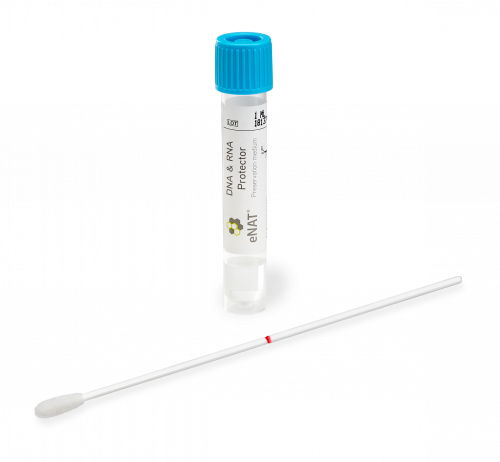
Sampling is carried out using the Copan FLOQswab™ (552C.80PB) and the eNAT medium (608C) from Copan, which also offers a corresponding kit (608CS01R). Both will be provided to you by your laboratory.
Do not use any lubricant before taking the sample for the WID®-easy test.
The sample collection for the WID®-easy test takes place
Detailed instructions on sampling can be found at the following link*.
The WID®-easy test detects the methylation patterns of tumor DNA indicative of endometrial cancer.
Conditions that restrict the drainage of tumor DNA from the uterine cavity into the vagina, such as large endocervical polyps or fibroids, may affect the sensitivity of the test.
The patient should not have vaginal intercourse without using a condom for at least 24 hours before taking the WID®-easy test.
* The specific instructions for sampling are the responsibility of the healthcare facility that produces and uses the test. These instructions will be provided by the health institution. The example presented here is a current working hypothesis.
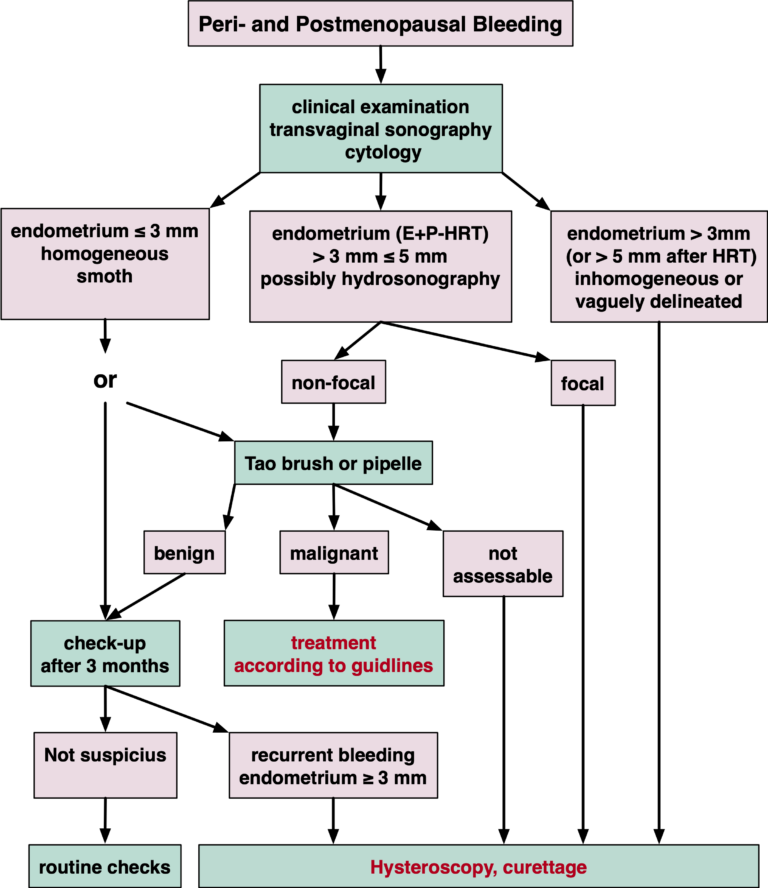
According to the current S3 guideline on endometrial carcinoma (AWMF register number: 032/034-OL, September 2022), transvaginal sonography as well as a cytological examination, are recommended after clinical examination.
Transvaginal sonography determines the endometrial thickness and, if the thickness is ≥ 3 mm, surgical, diagnostic procedures such as Tao Brush™, Pipelle™, hysteroscopy and curettage are recommended.
In women with peri- and postmenopausal abnormal bleeding, this threshold is reached or exceeded in over 50% of cases.
(Evans et al., The Lancet Oncology, 2023).

The WID®-easy test is characterized by extremely high values for sensitivity (90.9%), specificity (97.3%) and NPV (99.7%).
Using the ∑PMR cut-off value of 0.3, the PPV of the WID®-easy test is 50 %, ten times higher than that of sonography, whose PPV is only 5 %.
(Evans et al., The Lancet Oncology, 2023)
Over 50% false positive
on ultrasound
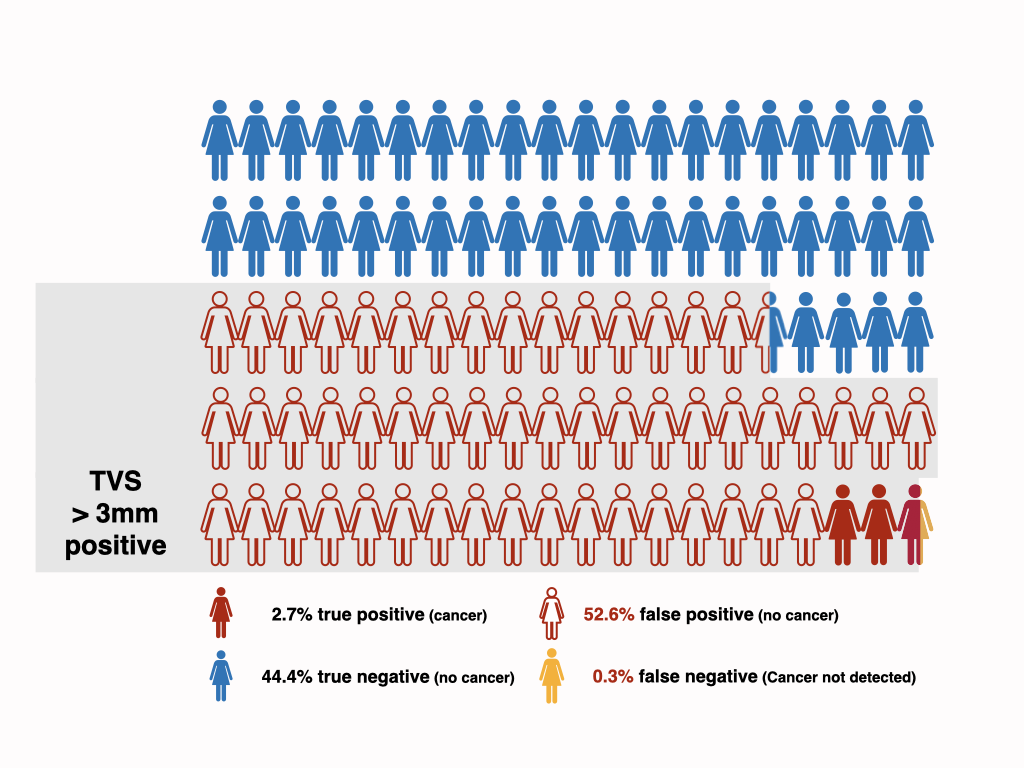
The gray area indicates the proportion (> 55%) of women with peri- or postmenopausal bleeding who need to undergo a surgical diagnostic procedure based on the determination of endometrial thickness by transvaginal sonography, although cancer is present in less than 3% of these women. This is a false positive rate of over 50%.
Less than 3 % false positives
with WID®-easy test

The proportion (5.2%) of women with peri- or postmenopausal bleeding who need to undergo a surgical diagnostic procedure due to a positive WID®-easy test result is shown here in gray. The proportion of false positive results is less than 3%. That’s a 95% reduction in false positives.
Extrapolated to 100 peri- and postmenopausal women presenting with abnormal bleeding, transvaginal sonography (“TVS”) will exceed the 3-mm threshold for endometrial thickness in 55 women. According to the S3 guidelines, all these women must undergo a surgical diagnostic workup (Tao Brush™, Pipelle™, hysteroscopy or curettage). More than 50 of these women will be found not to have endometrial or cervical cancer. Thus, a false positive result was present.
Because of the higher specificity of the WID®-easy test (97.3% WID®-easy / 45.8% TVU), which results in a significantly higher positive predictive value compared with transvaginal ultrasound (PPV 50.0% WID®-easy / 4.9% TVU), the WID®-easy test suggests invasive workup in only five women. That’s a 90% reduction in invasive procedures. Half of these women will be diagnosed with cancer in the histological examination.
The false positive rate is twenty times higher with ultrasound than with the WID®-easy test (52.6% vs. 2.6%). Using the WID®-easy test can therefore avoid 95% of invasive diagnostic procedures in women who are ultimately found not to have endometrial cancer.
Sensitivity, the negative predictive value (NPV) and the rate of false negative results are comparable for both methods.
(Evans et al., The Lancet Oncology, 2023)
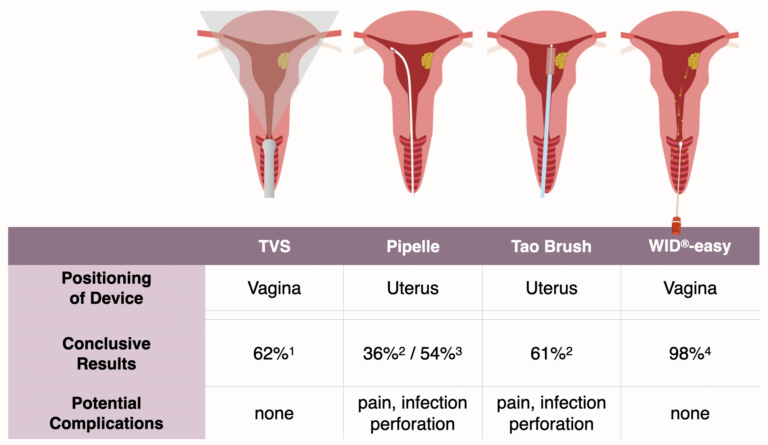
In addition to the convincing performance of the WID®-easy test (sensitivity, specificity, NPV, PPV), the test is also characterized by superior robustness. Furthermore, it can be assumed that the test will not lead to any complications.
In almost 40% of cases, transvaginal sonography and the Tao Brush™ must be expected not to yield a conclusive result. In the Pipelle™ test, the expected value for the proportion of unambiguous results tends to be below 50%.
Performing the WID®-easy test, on the other hand, almost always leads to an unambiguous result (98 %).
Pipelle™ and Tao Brush™ examinations require insertion of the instruments through the cervical canal into the uterus. This can result in pain or infection, and in some cases even perforation of the uterus.
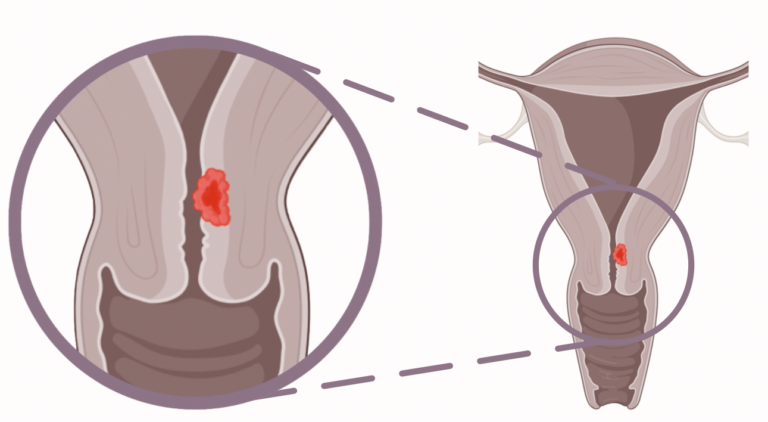
Endocervical carcinomas cannot be detected during visual inspection using a speculum. Furthermore, these do not lead to an increased endometrial thickness and also remain inconspicuous in cytology.
In a case-control study, the WID®-easy test detected 21 of 22 cervical carcinomas, giving it a sensitivity of 95 %
(Schreiberhuber et al., International Journal of Cancer, 2022).
When endometrial cancer is suspected, rapid workup is critical to maximize survival if endometrial cancer is indeed present (Sud et al., The Lancet Oncology, 2020).
In case of a negative WID®-easy test, conservative treatment of women with abnormal bleeding and active monitoring with transvaginal ultrasound and the WID®-easy test is a real option.
You spare your patient a surgical intervention in the hospital and remain in close contact with your patient as her primary contact person during the conservative treatment.

If you are using the Elementor Accordion widget, you usually need the title and the body text separated so you can paste them into the "Title" and "Content" fields of each item.
Here is the cleaned-up text with the "Item" labels removed, ready for your accordion:
Performance of the WID-qEC test versus sonography to detect uterine cancers in women with abnormal uterine bleeding (EPI-SURE): a prospective, consecutive observational cohort study in the UK.
Study Scope: 400 women aged 45+ with peri- or postmenopausal abnormal bleeding at UCL-Hospital, London.
Key Finding: Reductions in unnecessary surgical procedures (hysteroscopy/curettage) by 87% compared to UK standards and 95% compared to DACH region standards.
Impact: Faster diagnosis and significant healthcare cost savings.
A Simple Cervicovaginal Epigenetic Test for Screening and Rapid Triage of Women With Suspected Endometrial Cancer: Validation in Several Cohort and Case/Control Sets.
Scope: Developed using 726 cervicovaginal smears; validated in 562 unrelated specimens.
Versatility: Confirmed effectiveness across three collection methods and two diagnostic/predictive settings.
The WID-qEC test: Performance in a hospital-based cohort and feasibility to detect endometrial and cervical cancers.
Validation: Tested in a real-life hospital cohort of 304 women.
Key Finding: Demonstrated superiority in detecting cervical carcinoma (especially endocervical) compared to standard cytology.
High-throughput implementation of the WID-qEC Test: DNA methylation-based test for the detection of uterine cancers.
Innovation: Describes the technical implementation and analytical verification of the high-throughput workflow.
Process: Covers automated DNA isolation, bisulfite conversion, and automated data interpretation for high-volume lab efficiency.
High performance of the DNA methylation-based WID-qEC test for detecting uterine cancers independent of sampling modalities.
Consistency: Results remained stable across different brushes/swabs and sampling sites (vaginal vs. cervical).
Stability: Validity was maintained even for samples stored at room temperature for seven days.
Performance of the WID-qEC test to detect uterine cancers in black women with abnormal uterine bleeding: A prospective observational cohort study in Ghana.
Accuracy: The test successfully identified 100% of endometrial and cervical cancers in the study population.
Global Health: Proves highly effective for ethnic groups where sonography performance is historically poor.
Providing Quality & Effective Solutions To The Research & Diagnostic Industry. Established in 2017, NextGen Molecular Supplies is South Africa leading suppliers of products and services to the biological research, diagnostics, and point of care market.
© 2026 NextGen Molecular Supplies.
Visit:
12 Clamart Road
Richmond
2092
Johannesburg
South Africa
Call: +27 87 148 9309
Email: customer_care@
ngms.co.za